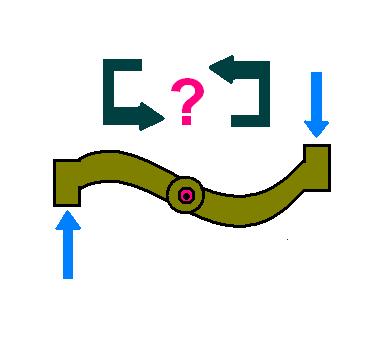
|| Welcome to the Blog managed by the KVPY 2005 Batch || Twish asks members to comment on the blog MaKeOvEr!! || RG says: Looks like a famine situation here || Blog glows in bright shades || KVamPys tame their own minds... with new mysterious posts on TP ?! || What is TP after all ? || KVamPYs start thinking about their Summer Projects as the Entrances are about to end.. || IIT? IISc? IISER? KVamPYs wonder where to enjoy this summer.. || Obiwan and Sunita in ISSER || Arun awaiting replies to his letter. || Swetabh ( Bhakt ) and Abhilash trying for IIT Kanpur ( Along with Twish ) || What about the next year ? Apply again for KVPY ? || Bulbs light up as blog fills up with posts. || Latest News brought to u by Twish (Twishmay) and Rash (EMAIL US NEWS) || EvErY bOdY KnOwS..... KVamPYs RoCk!! ||
Showing posts with label Puzzles. Show all posts

Friday, January 05, 2007

Biology & Astronomy - Questions, not Answers

Alright. Two things being tossed off my mind here.

1) Why February?

So when the calender was first made (gregorian), the months were given days according to the motion of the moon. Also, it was noted that a year is about 365.25 days, so a leap year was added every four years to negligate the approximation of 365.

However, it was noted that the days in one month had to be truncated to fit in 365. And then they truncated them from Feb. And now we can't rely on the day of the month to find the location of the moon.

But why were these days removed only from Feb? Why weren't the number of days in every month made equal?

2) Negative Half-Life?

Although a half life is negative, as in it is for decomposition, is there anything opposite to the phenomenon of exponential decomposition?

Take the example of Cancer cells. They divide, then the two cells again divide etc. The rate of reproduction increases over time. My question is, is there an accurate exponential formula for this? There really should be, according to physics, but there may be factors which inhibit the reproduction of a particular daughter cell of a cancereous parent...

3) Time travel

You will just have to wait for the release of my book.

Thursday, December 28, 2006

Strange wall-ball problem


Okay I get it - the title is not that imaginitive.
Hi there! The organic post that was to be never came up because I left my copy back in school but its some pretty interesting isomerism nuts that I was shown by my teacher. For now its some physics- collision style!
In fiitjee and other study mats there is always this obscure thing that concerns a ball with a wall. (Wall=infinite mass, ball=m)When the ball collides with the wall having an initial velocity u it returns back with the same velocity provided that the collision is elastic. Now fix the ball, let the wall strike the ball with a velocity u.Whatt happens now?

Contrary to all common sense the ball lurches forward with a velocity 2u.why??
A friend of mine kaustav sengupta (never mind the too erudite tone of the sentence) made sense when he said that consider the first case as in figure1, the frame instead of being stationary with respect to the ground is having a velocity u to its right. then?/Â…..we get the second case, fig2, minus the comment about not making sense.
Comment if u knew it
Comment if u did not
Comment if u think itÂ’s wrong
Comment anyway!

Wednesday, October 25, 2006

Whatz prooved & Whats not :: A DEAD END SUPPLIMENT !

Hey all !

Hmm ...
Another Dead End ? Nope I'm saturated of those now. But this one's interesting enough to be brought to notice of the blog.

A seemingly remarkable proof indeed for prooving that all numbers are interesting !
But Can a subjectivity of the problem be discussed mathematically ? The answer seems to be yes !?!

Now lemme introduce you 2 a couple of DEAD ENDS :

(1)

To Proove : Every natural number N can be described within 15 words.
Assumption : Let there be a set S of number which cannot be expressed within 15 words.
Ordering the set S & pickig out the first element, say P we get P as :
P is the "the smallest natural number that cannot be unambiguously described in fifteen words or less".

:. P can be described within 15 words.
By Reductio Ad Absurdum ;
We herey proove the Statement that :
EVERY NUMBER CAN BE REPRESENTED WITHIN 15 WORDS.

(2)

I begin this one, relating to the THEOREM OF MATHEMATICAL INDUCTION as quoted by Arun in a comment to the previous post.

"

The principle of mathematical induction basically is a logical proof of extention. If you can show that:
1) The statement is true for the base case, i.e. 0 generally,
2) That if it is true for n, n-1, n-2, it IMPLIES truth for n+1.

"


Okay. Let there be a statement S(n) depending on n which can be either TRUE or FALSE.

I DEFINE S(n) as :
S(n): "In ANY group of 'n' blog-members, all have equal ages."
OR
"In a set of blog-members-ages from ANY particular blog, all values are equal."

Now proceeding on the lines of the above discussed theorem, lets discuss S(1).
: " In ANY group with 1 blog-member, All blog-members have equal ages ( Takin one member at a time since n = 1 )."
Clearly S(1) is TRUE.

Assume that S(k) is TRUE which implies that :
: " In ANY group of 'k' blog-members, all have equal ages."

Now to proove S(n) for all N belongs to (1,infinity), We must proove S(k+1).

So now we have a set of (k+1) blog-members. Of those, we can choose different combinations of 'k' blog members. In each of these combinations, all blog-members would have equal ages. Therefore, All blog-members in the (k+1) blog-member set are equal in age.
:. S(k+1) is TRUE if S(k) is TRUE.


S(1) is true. S(k+1) is TRUE When S(k) is TRUE.

:. by the THEOREM OF MATHEMATICAL INDUCTION ...

S(n) is TRUE.

Implying this for the blog KVPY2005 : Fused Bulbs... I hereby proove that all memebers in this blog are equal in age, which is conincidentally true within the limits of error. lol.


Ill leave the implications to be discussed by the blog members.

WAITING FOR COMMENTS

(desperately hehehe)

Twish

Tuesday, October 24, 2006

Boring Numbers?

Hey. It's been a long time since I've posted anything, so I'll make a candid proof I saw on the net somewhere.

This deals with a really fundamental theory:

There is no such thing as a uninteresting number.

As we deal with the earth-shaking proposition, one must have a deep fundamental knowledge of sets. Let us limit our theory to the infinite set of natural numbers.

On with the proof:
Let N be the set of all natural numbers, of which X represents the set of uninteresting number. First let us order this set X in numerical order. Let us now analyse the first number of this set. Our understanding of what makes a number interesting is so fragile that to produce such an example is a great step forward. Thus this number being the FIRST uninteresting number is of vital importance, bringing our interest to it. Thus it can not belong to the set, and isn't the first element. Let X' be the revised set omitting this fraud. Thus the second term of set X is the first of set X'. We can apply the same reasoning here, and easily omit this element, and continue to do so for all other numbers of the set, making it a null set. Thus it is easily proved that there is no uninteresting number.

Lovely proof isn't it? But there does exist a very important logical consideration. If one considers ONLY the negative numbers, our present ordering is befuddled, but do not panic. Suppose we order them in REVERSE order, letting greatest come first. Thus we can proceed by the same steps as above.

Now, we come to a very important juncture. If we combine these two sets, and look at ALL integers, we're stuck. For sure the negativity is an important difference between '+' and '-' numbers, and we can't ignore it. A set of Z has no beginning or end, so we CAN'T order it, and use this lovely proof for it. So it seems that the interesting-ness of certain '+' or '-' numbers makes other numbers loose there interesting-ness. But I thought interesting-ness was an intrisic property of a number. I.E. that a number can be called interesting because of a property that it exhibits, i.e. primality (it being prime) or it's square-ness/cube-ness/n-power-ness, or a pattern exhibited by its digits (like 12321).
Appealing to this logic, we could either conclude two things: That there exist no uninteresting numbers, or that the interesting-ness of a number does infact depend extrisicly as well as intrisicaly, and that it depends on a negative counterpart (whether that is the negative of the same number or not can not be concluded though).
As much as I'd like to take the latter, for it's more complicated, and that it IS earth-shaking in its statement, I'll abuse Occam's Razor and say that the former is obviously true.
Occam's Razor is: All explanations are simple, and the more complex one is more probably wrong. Note the keyword: Probably. It's generally quoted with overexagerrations like:
When you see a reflection:
1) Light is getting reflected
2) There is an alternate reality, which can be entered through the window, and which is inhabited by people who look EXACTLY like you, and happen to do EXACTLY what you are in front of the mirror.
Sometimes I think that life would be a lot more fun if it weren't so obviously 1.
That's all for now. I hope to be back this weekend with a post on the brain.
Signing off and Id Mubarak,
Arun

Sunday, October 22, 2006

BEFORE THE BEGINNING AND BEYOND THE END (PART 2)

Hello again all of you. I am back, with a spicy second part of my article. The contents of this article as well as the one it follows is a collection of well laid facts cemented with the author's own ideas. Thanx 4 reading guys, enjoy. Please refer to the previous section wjenever in doubt.


Let us now extend our view of the symmetry about the big bang, we can go forth to say that the previous universe too must have originated from another big bang. Therefore, this brings us back to the concept of oscillating universe theory. However, the problem with oscillating universe is Entropic considerations. The problem is the following:

The oscillating universe theory says the entropy of all the singularity states of the universe have same entropy. Now let us assume the whole of the universe as one system. Suppose right here right now, I drop an egg and break it. I have thus increased the entropy of the universe. However, when our universe reaches its next big crunch, the entropy has to be same as that of the last singularity. There is the problem, entropy remaining constant although the system is experiencing an irreversible process. I will try to provide an explanation for it.

All of us know about supernovae explosions. Some parts of a dying star blows off as a huge explosion into the realms of the vast universe, and the remaining collapse into a tiny dwarf star. Let’s apply this logic to the entire universe.

Let S1 and S2 be two singularity states. A big bang at S1, expansion, and then contraction and finally a big crunch at S2 are the sequence of events. The change in Entropy is ΔE. According to Boltzmann postulate or the definition of Entropy,
ΔE = kb (ln Ω1 - ln Ω2) where, the sigma are the no of ways in which the same microscopic arrangements can be restored from a starting state.
So what we do now is very simple. We ‘transfer’ all the disorder in the whole of the universe to say a few moles of gas molecules. We outcast there molecules and allow the rest of the universe to move into singularity 2.

Let me make this more lucid. While playing billiards (or pool or snookers ... whatever), on a perfectly friction less table, we first break the triangular arrangement in the middle by a slow strike, the balls go a little haywire and keep moving and colliding with each other. As these collusions continue, the entropy is constantly increasing with time. But there is a remote possibility that say seven of these balls will again come back and form a tight arrangement. The remaining two will remain in a state of even increased randomness. Thus we can say that the entropy got localized to the two balls or got transferred from the other seven balls to the two.

This is one way in which we can satisfy both the oscillating universe theory and the second law of thermodynamics. But this too has a lot of problems of its own. First and the most important is that it is unable to explain the birth of the universe (I am talking about the real birth – the first big bang) and it too says that there has to be some thing beyond our universe.

It says our universe is constantly losing its mass into darkness (dark energy?). It predicts a very gruesome death to our lovely universe. A heat death scenario – a situation when there will be no energy gradients and hence there will be no process. (All processes require flow of energy.) But certainly it has done one good thing for sure, it has increased the life span of our universe to much beyond of what Big bang theory had proposed. It never says that the Big bang theory is wrong but it says that the big bang was not the beginning but only a phase change in the history of our universe.

I will not end this article with a conclusion as conclusions are for the readers to devise. It is a philosophical question and until we find a proof we can only speculate. We are like a child who presses its nose on a mirror, accepting it to be window. He knows it is not the reality. It is only the preconception in his mind. Reality lies beyond the glass- break it open. But he is afraid that in the process of breaking open the mirror and discovering the reality, he will destroy his well constructed sand castle.

Saurya Time Mishra

PS: Sorry if u couldn't c the comments before. Dunno y, but still, u can add them now!

~Gr81~

Sunday, October 01, 2006

BEFORE THE BEGINNING AND BEYOND THE END

Part 1


There was nothing at all, no space no time (not even me), then all of a sudden it all happened - The Big Bang. A theory we all have believed so blindfolded. A Theory that created a bigger bang in the world of science than the Big Bang itself. A theory that certainly could explain cosmic background wave and the red shift of the expanding universe, and even satisfies religious claims of things like God making everything. Everything is completely all right until we step beyond the beginning. People have asked numerous questions, “What was there before Big Bang?” The scientific community with a Godly authority turned all of these questions down. I will not repeat them.

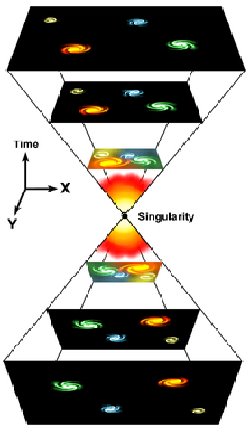
But this was not all. This theory at last seems to be breathing it’s last (and thank God). The theory, which was once rejected, is now betting a rebirth – The Oscillating Universe theory. The General Theory of relativity, which so well explains everything regarding gravity, fails miserably in what we call Singularity – space and time condensing to one point – densities touching incredible values and distances reducing to about 10^-39 - the plank scale. And the reason? The same thing, which my dear blogmate Arun and I have been arguing upon – Calculus. We all know that charge is quantized, so is angular momentum of electrons, even mass. Let us take a step forward and extend quantization to time and space. Space is nothing but a fabric woven out of individual fibres. Calculus cannot be directly applied over discontinuous space. However applying it with a little modification allows us to end all problems. This theory is popularly known as the Loop Gravity Theory and interestingly but as expected originated in India.

The Theory was aimed at explaining the physics at plank scale which it did successfully. However, it led to another implication and directly counters the concept of the Big bang.. When all matter in the universe approach singularity, the theory says, there comes into play a force – one of tremendous magnitude, manifold greater than gravity itself and repulsive in nature. The situation is similar to a ball hitting a spring and bouncing back.

Certainly with this knowledge we can answer the most controversial question, “What was there before the big bang?” The answer is there was the countdown to a big crunch. We now have a universe that does not begin at the big bang, but only is symmetric about it.

What I want to say is here – Wasn’t it Obvious? We should have guessed it earlier. Let me explain why and how.

I would like to repeat the philosophy of a 2nd century Chinese philosopher. Every event is preceded by another event. (The former is the cause of the later) Hence, the implication follows that there has to be some thing before the Big bang the cause of the Big bang, more specifically. (Speaking further, we can say that there should be no beginning to the universe, but we will see to that later) To further justify the statement, and denounce the creation of space-time at t=zero (and with it the Big bang theory), I will give the following argument.

Let us say there was a primeval atom, which exploded to create the universe, space and time. The question is why at all did it explode? This can be answered in two ways. Firstly there was some thing (or someone …say God) outside it who/which caused the Big bang to happen. That means, there was something – matter, energy or say a consciousness excluded from the Primeval atom. But this is against our Big bang theory. The second way is to use probabilistic mechanics. The primeval atom just like a radioactive atom had a probability of disintegration at any given time. (I am sorry, but using probability without the concept of time is just impossible.) So there has to be Time before Big Bang. This again violates the Big Bang theory.

I would love to write more but its not possible in a single blog. I will put it all in the second part very soon. So stay tuned, the sting is in the end, I assure you.

Saurya "Time" Mishra

Friday, September 15, 2006

ENTROPY has INCREASED AGAIN

HEY BLOGMATES !!!

& Heyy Arun...
Your previous comment appeals to me big time for I'll share something with ya pal ! Even as I write this, therez a thought in my brain telling me to do it with adibatic & reversible processes as far as possible so that there is least increase in the entropy of the universe. When I walk, I think of taking the shortest route possible only because I don't want entropy to increase. Only that I realized it sometime last year that thinking to conserve entropy, I was infact increasing it ! The entropy I saved walking a hypotenuse-cut through a park was little compared to the effort I spent thinking about it. The heat released in my brain, the possible disorders etc etc.
Today it occurs it me, whether it was of any use ? Is entropy actually that bad ? Infact is a broken glass any worse than a not-so-broken one ? Well, science discusses the objectivity of a problem but what decides its subjectivity ?
Infact whats the definition of wrong & right ?
NOW ... thats too many questions at once ! That too very much varied.

Well. Okay. what about "" DISORDER "". Thats what ENTROPY if a degree of. But if ""DISORDER"" really that objective ? Or mayb we can define DISORDER in terms of entropy. Well, then is an act of murder a disorder or order ?
Im sure this is not a question answerable by science. Nor does science intend to adress such queries. But wat about them ?
I have a little piece of writing on entropy that I'll shortly post, something that I wrote an year back.

As for H U P , hmm... even I went through the same thoughts once! Though its intriguing to know that waves of particlas are considered to be waves only because there is to means to look into the wave !
Infact the de-Broglie thingy is pretty much the same thing as the HUP... just 2 ways to say the same thing. The same thing being that weather we say that there exists a particle which is smeared across a region in space, or there's a wave not a particle which is present, its the same thing !

Indeed theres a lot of similarity in our thinking Arun ... hmmm

Newayz.

Will try & be regular with some posts !


TWISH
PS: Sry Gawd for all this increase in entropy...

Saturday, September 02, 2006

I Hate Capacitors

Hi guys,
Some thing has been eating me for days. Its about capacitors and may sound trivial but I wil assure u it is not so. The question is: "what will be the capacitance of a parallel plate plate capacitor when it is filled with a conductor touching both plates."
All books I have seen so far say it will be infinite or tends to infinity, but i dont agree. I will put my view point.

let us go to the grassroots and define capacitance. The ability of a capacitor(or any object for that matter) to 'store' charge at a given pottential difference. Now once both the plates are connected the whole assembly is nothing but a conductor. Two statements here:
(i) Any conductor except a superconductor has some resistance, no matter how small, it is non zero. Thus there will be some pottential drop. V not= 0
(ii) No part of a conductor can accumulate any net charge, because of the presence of charge carriers (electrons). Q = 0
Thus the capacitance C = Q/V = 0/non zero = 0

Now some thing very very absurd(funny rather) is written in one of the books (Arihant Electricity and magnetism). It say since a conductor can allow infinite amount of charge 'though' its plates, Q>>>>V. So C tends to infinity. Wah bhai !! Listen to my analogy. Take a bucket, cut off its bottom and say u have a bucket of infinite capacity !! LOL !!

Intrestingly and disgustingly nearly all physics trachers disagree with me. i am the lone fighter for my cause. I have ddecided to conduct an extensive experiment on this starting from 25 Sept after the FIITJEE exam ;) So what do you people think? Am I wrong ?

Saurya Time

Sunday, August 06, 2006

The Chaos Game

Here's about a lovely game I've been playing for the past week or so (it really screwed up my study schedule). It is just one of the pinnacles of the beauty of random processess. I hope you know I'm not talking about a computer game or sport.

I'll describe the basic process of the game now. It's very simple. Take a number of points (generally start with three, you can't do more without a program) on a piece of paper. Now supposing you've taken three (I'll assume you can all generalise it) points, considered vertices (A, B, C). Actually, these vertices need not be in ANY regular conformation. But again for aesthetic sense, consider them in an equilateral triangle. So you have three points in an equilateral triangle on a sheet of paper.

Now mark a point anywhere you like, inside the triangle, outside (even at infinity, but thats a wee bit impractical). This is your initial point, technically a seed. It really doesn't matter where its taken. Take a die (or create a random no. program). Assign two numbers to a vertex (if its a good die, which we assume it is, each no. has equally probability, so it doesn't at all matter). Suppose the following assigniations: A = (1,2) B = (3,4) C = (5,6). Roll the die, and mark your next point at the mid-point of your original point and the vertex indicated by the die. Roll the die again, and using the new pt. generate another pt. Continue doing it ad-infinitum (or till you go mad).
For example, let your initial pt be S. You roll a 4, then, mark X1 at the midpt of SB. Roll again, and get 3. X2 = midpt. of X1B. Roll:1. Mark X3 = midpt. X2A. Go on and on.

Honestly tell me what kind of figure would expect from such a random process. Some would say a filled triangle, and fewer a random figure that doesn't quite cover the entire triangle.

Time for some pictures eh?
Here is the plot for the above:
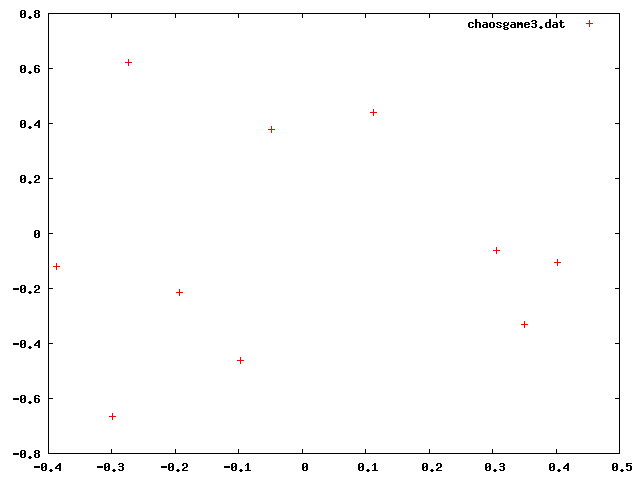
1. Plotted with just 10 points. No structure is inherent:

2. Plotted with 100 points. Some structure visible:

3.Plotted with 1000 points. Structure is glaringly obvious:
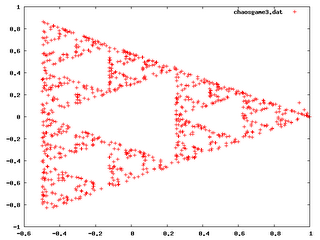
Just goes to show that the human intuition is extremely biased on its experiences. I've read two books about chaos, and a good portion goes in droning about how we've accustomed our minds to complex stuff can be achieved only by complex processes, and random processes bring out random results. The above figures tend to form the Serpienski Gasket, which is a figure that can easily be drawn through the process: Take a triangle, and exclude the triangle formed by joining the midpt of the sides. Do it for every single triangle you get. This is and example of a figure with INFINITE length but ZERO area. Another feature is that the figure is infinitely detailed, which means that it never lands onto the same spot, and no matter how deep you go into the figure, you will still see detail which is microscopic at that scale. It is also absolutely self-similar.

Either way, to extend the figures, we can take the points as 4,5,6, etc. (4 it comes out doesn't show anything, its and exception). We can also change the recursion to give:
X2 = (Vertex + X1)/R, where R is the ratio. Here we've taken R to be 2, and got the midpt. For different R, it doesn't exactly give us that.

So here are some more interesting pictures:

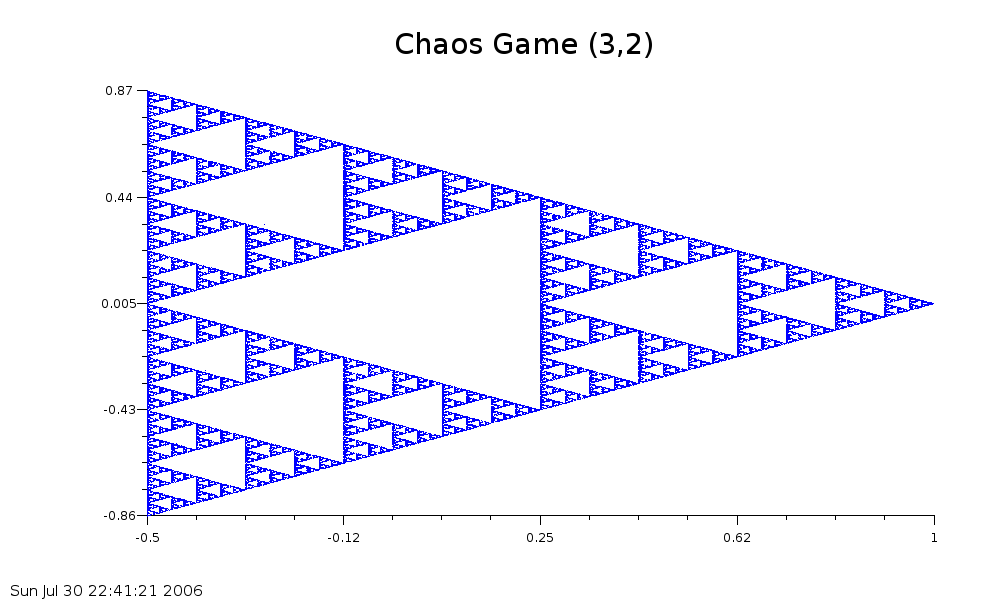
1) The same triangle, in much better detail (10^5 with a bettter plotter LabPlot, also freeware):
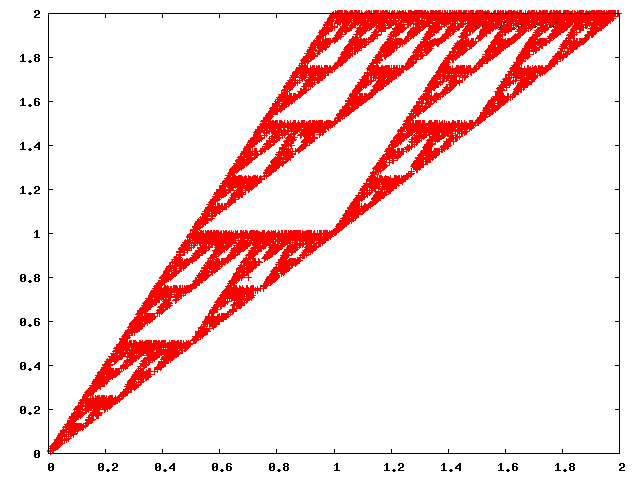
2) A skew triangle, just to show you the lack of need for regularity:
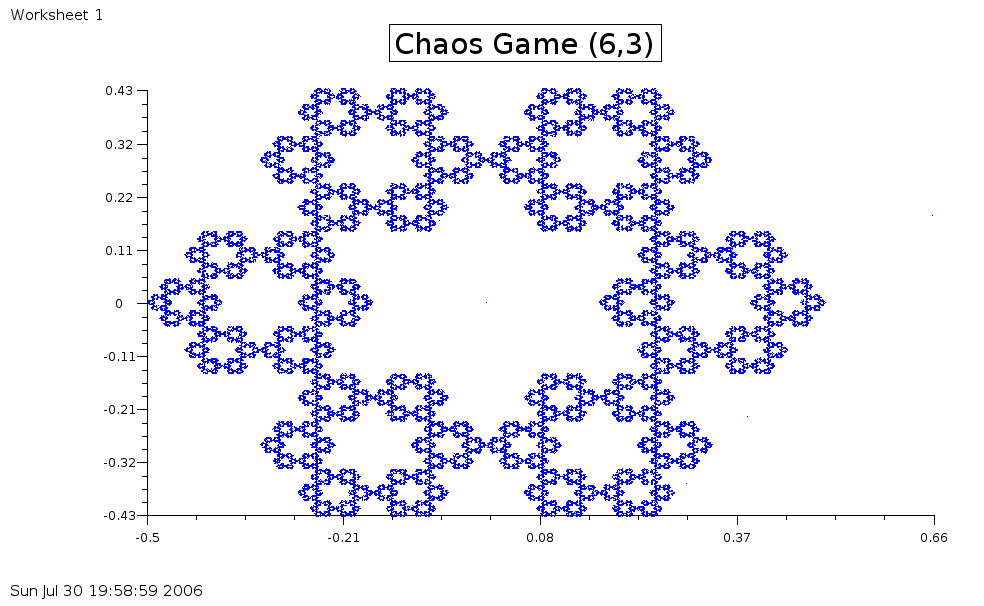
3) A hexagon with ratio 3. This is undoubtedly the most beautiful thing I've created (I don't draw very well):
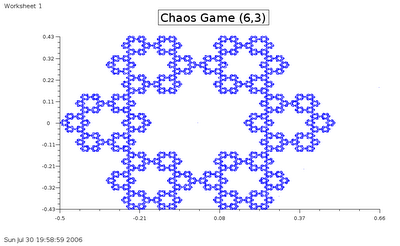
Just some more notes, the figure in the center is a Koch Curve, which to people who've read it is an amazing revalation, because of the amazing shape that it is. Just to tell you, take an equilateral triangle. Take the middle third of each side, and split it open into two parts to form an equilateral triangle with the side = 1/3 of the base length. __ becomes _/\_, with better ratios of course. Keep on doing this. It gives you finite area, but infinite length.

Ok. One last note: You really should try to experiment with this. You'll come across a lot of interesting, and semi-obvious realizations. For example, by changing the ratio R to 3 for the triangle, you'll get a similar triangle figure but each triangle will be a bit spaced. If you do the hexagon, with a ratio of 2 instead, you won't be able to make up much. Extrapolating ,the ratio gives how far apart they are, with too small a ratio, they'll overlap and you can't make out anything.
For further reference:
MathWorld: http://mathworld.wolfram.com/ChaosGame.html

Sunday, July 02, 2006

Little time, lots of confusion


Let me clarify a few things first up. I am Ankit Sagwal,one of the guys from Dps Rk puram and not the immensly popular ankit pandey(by the way, where is he? still not found the time to join).I will post my photo as soon as i figure out how to do it(maybe that would work). I have not gone through the blog yet(its a lot of text) but i'll surely do it.
I think this space is meant for something more interesting rather than a general talk. Ok lets give you one of my favourites:-

The task is to fill 1cm diameter spheres into a box(cube) of 10cm edge.find the best pattern as well as the maximum possible no.

Short and smart!!

the next few lines might act as an apetizer for u guys(and gals-i can see a lot of them on the list). The question is not as easy as some of the first timers might think. Others might have done the 2d version of it(i should have given that first-comparetively easier)

a square of side 10cm is to be filled with circles of 1cm diameter. find the maximum no.

hint:- slightly more than 100

I think this should be it.Think over it.

Maths has always been a treasure (this is one of the gems)
I've got to rush, make my substitutions in the timesdreamteam(i wonder how many kvpyians know about it(fantasy game of football similar to super selector)) and then get down to study for my maths exam tomorrow(oh!! i have to start taking school exams more seriously).
byeoo

Posted by ANKIT SAGWAL

Friday, June 02, 2006

DEAD ENDS : Part III : Justified lies


Here I am !
Bored of 2=1s aren't ya'll ? Here are some more of classic lies, told in the most decieving manner !


(1) *** classic *** ( Some PHYSICS for a change )
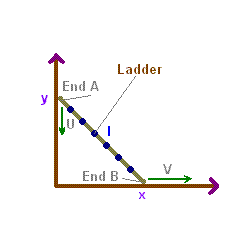
There in the figure, we have a ladder leaning against the brown wall. Its length is l & the two ends are labelled as A & B. End B is pulled in the positive direction of the x-axis with a constant speed V. The velocity of end A in the downward direction is U ( variable ). x,y are the respective coordinates of the two ends.

x2 + y2 = l2

differentiating w.r.t. time we get :

2.x.∂ x/ ∂t + 2.y. ∂ y/ ∂t = 0

2.x.∂ x/ ∂t + 2.y. ∂ y/ ∂t = 0
2.x.V = - 2.y.U(x)
U(x) = - x .V/ y

Now, when ladder falls completely, and becomes flat, then y = 0 & x = l.

To calculate the veocity of end A when ladder just becomes flat, we put the values in equation for U(x) getting :

U ( l ) = - l.V/0 = - ∞

So the velocity of end A becomes infinite when the ladder becomes flat ? !


(2)
We are all aware of the theorem of Mathematical Induction. However, none would have seen its misuse. Here is one such misuse which is horribly difficult to disproove !!!

Statement to be verified is :

S(n) : In any set of n people, all would have equal ages.

Now we proceed :

S(1) is true ( Since in a group(set) of 1 person, all have equal age. )

Let S(k) be true.

Now ;

In a group(set) of (k+1) people, we make all possible sets of k people. In all these possible set of n people, S(k) would be true (as per assumption) and hence all people in each of the sets would have equal members. Now since all such possible sets would have members of the same age, this is only possible if all the members in the (k+1) member be equally aged. Therefore All people in the set of (k+1) people have equal ages.

Hence S(1) is TRUE & S(k+1) is TRUE whenever S(k) is TRUE.

Hence prooved by mathematical induction , the TRUTH of statement S(n) for all n belonging to N.

Application of the above theorem for the set of BLOG MEMBERS "B" We conclude that All members of this blog are of equal age.
QED


(3) *** classic ***

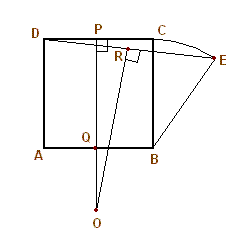
ABCD is a square. BE = BC.
PQ bisects CD,AB.
OR is perp.bisect. of DE.
PQ, RO intersect at O.
∠ ABE is an OBTUSE ANGLE. ( clearly )

Δ ORD ≡ Δ ORE (SAS)
:. OD = OE

Δ OQA ≡ Δ OQB (SAS)
:. OA = OB & ∠ OAB = ∠ OBA

Δ OAD ≡ Δ OBE (SSS)
:. ∠ OAD = ∠ OBE
∠ ABE = ∠ OBE - ∠ OBA
= ∠ OAD -∠ OAB

But ∠ OAB - ∠ OAB
= 90 °

:. ∠ ABE = 90 °
However, we've assumed the angle to be obtuse. :. Every obtuse angle is a right angle. Similarly, It can be shown that every acute angle is a right angle.
QED


This is part III and I'll let ya'll know that 3's my lucky number. So hereby, I quit with this series. Not that the resources are over ! Infact they're endless. But today eve, I'm leaving for Delhi & I won't be able to be online so regularly. Though I'll surely stay in touch atleast twice a week !

A last message. I believe that us KVamPYs are special in some way. I also believe, that we can be a great strength when united ! So here's a request. Mayb you can't come online very often but do stay in touch by atleast going through the blog once a week !!!

This blog is for us KVamPYs, by us KVamPYs & of us KVamPYs.

So letz ROCK ... letz RULE !!!

& Ill borrow Rash's line...
SwItCh On Ur BuLbS !!!

~ Twishmay Shankar ~

( Twish ;-) )


span>


Thursday, June 01, 2006

I HaVe ThE POWER!!

Well, does the title remind you of the classic “He-Man” Cartoon series?? Well I’m not posting about cartoons but this has to do with “Power.” But that’ll come later.

First of all, I wanted to post my intro too but was waiting for Twish to mail me the pics from the camp. So that’s me saying: ”I have the Power!!”. You want a formal Intro? Here you go:

Rasagy aka RashTheGr81 at KVPY Camp

Name: Rasagy Sharma (a.k.a. ‘Rash’ The Gr81)

Residing in: Delhi

Interests: Dramatics (Done loads of TV and Radio Shows), PlayingSoccer (Some of you who played with me know that – It’s a second religion for me!), of course anything to do with Computers (I just luv Computers!) and last but not the least, making Friends (and continuing the friendship too!)

Enough about me. So after reading Bravura’s post, I was sitting in front of my computer wondering about what went wrong there. Got some ideas, but couldn’t join them all up. And then a short chat with Twish only raised my ideas to higher powers… Yes. It was powers about which I have been thinking all night. Well, most of such weird looking problems arise from the fact that what we have been taught about powers, multiplication etc. is too basic (coz we were too young to understand complex nos. at that time). And even now, we haven’t updated our information about such elementary things, though we do know complex nos. etc. And thus arise such ques.

Well here are some examples:

1. 10 = 20

Then won’t 1 = 2 ?? (Say we have 2x=22, then we say that x = 2, don’t we??!!)

2. To prove: 3 = 4
Proof:
Let a+b = c
4a-3a + 4b-3b = 4c-3c
:.4a+4b-4c=3a+3b-3c
:. 4*(a+b-c)=3*(a+b-c)
:. 3 = 4

Maybe most of you can find what’s wrong up there (I think you all Should find that out easily!). But ever wondered why even your computer’s scientific calculator can’t compute (-8)1/3 ? Even though the answer is an obvious -2 ? (It says invalid input for the function: Got some clue??). Though its fine that it can't compute (-8)1/2.

Another nice problem (which Twish told me during the camp) is the following:

We know that

4*4 = 4 + 4 + 4 + 4

:. 4*4= 4 + 4 +… 4 times.

:. x*x = x + x + … x times.

Differentiating,

2*x = 1 + 1 + 1 … x times.

:. 2*x = x

Hence 2 = 1!!!

All such problems arise because we forget our assumptions – the definitions of the functions – the domains of the functions and we tend to generalize a formula we learnt in junior classes here.

Now what I was thinking was this:

x = 11/3

Then x3 = 1. And we get the solutions for x. So as this n increases, the no. of solutions for x also increase (which is n itself).

But if n-> infinity , we get only one value for x = 1. (Actually here we can’t replace n by infinity as n-> infinity but n is not equal to infinity.)

Also,

2 0 = 1
1 0 = 1
0 0 = ?

Well infact 0 0 an indeterminate form. So we can treat it as an exception.

But what if n is a complex no.?? According to Twish, it’ll lead to infinite solutions for x. I reckon that’s what messes everything in Bravura’s problem. So can some body explain to me what’ll happen with complex powers? (Do we have any physical interpretation other than just saying Z = 2 i finding Z??)

Sorry for writing such a Llllllooooonnnngggg post, but I think it'll compensate for my absence in the coming few days when I'll go out of station. So I hope to find many posts by then (posts by members other than Twish's Dead Ends - come on others plz post!)

And before ending, a bit of cheerleading… (yeah I’m at least good at that!) U ppl are doing a gr8 job posting stuff, but do visit the blog regularly (Too busy studying huh?) And do give more ideas as to what more to add in the blog..

So SwItCh On YoUr FuSeD BuLbS!!

~RashTheGr81~

DEAD ENDS : Part II : Burning Reality

Hi Again
As promised, here is PART II ...
Bewarethough !!! I'd certainly say this one is more wierd, more interesting but still a LIE which has been imposed wrongly upon reality :

(1)
Every1 here knows the pretty little Binomial thorem going as :

(a+b)n = an + n*b*an-1 + ... + n*bn-1*a + bn
Observing we find that leaving the first and last term, all other terms are a multiple of n.
For some wierd results, let us put n = 0 ;
LHS = (a+b)0 = 1
RHS = a0 + 0 ... + 0 + b0
= 1 + 0 ... 0 + 1
= 2
:. since LHS = RHS
2 = 1
QED
(2)
Consider the integral :
I = ∫ 1/x ∂x
Intigrating by parts ;
I = ∫ 1*1/x ∂x
= x*(1/x) - ∫ x*(-1/x2) ∂x
= 1 + ∫ 1/x ∂x
= 1 + I
:. 0 = 1
or, 2 = 1
QED
(3) *** CLASSIC ***
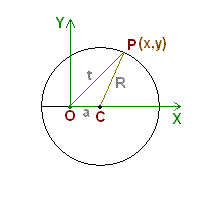
Have a look at the figure. O is the origin. C is the centre of the circle. P a variable point (x,y).
t = OP ; R = CP ; a = OC
The equation of the circle would be:
x2 + y2 -2*a*x + a2 - R2
Now, t2 = x2 + y2
Also putting P(x,y) in circles equation we get :
t2 - 2*a*x + R2 - a2 = 0
:. t2 = 2*a*x + R2 - a2
2*∂t/ ∂ x = 2*a
Now for the point with minimum distance , The above expression equals 0.
For that to be possible, a = 0, that is O and C are the same points !
Hence Whenever O is not the center of the circle, there is no point on the circle from which the distant of O is maximum or minimum.
QED
There is still more to come. Before thinking about the faults, appreciate the beauty of these propositions, how decievingly they proove the unproovable !
This in not the end.
~ Twish ~

NOTE : Those having difficulty typing math visit this link for keyboard codes :

Wednesday, May 31, 2006

DEAD ENDS : Part I : Spark to a Fire

Hey Blogmates !

The last post reminds me of something I've been doing for years! Something, which I was avoiding to put up here. But now I've lost all patience so here I begin with a series of posts, which to me atleast are damn interesting !!! I hope you all enjoy it...

(1)

- 20 = - 20

or, 25 - 45 = 16 - 36

or, 52 - 5*9 = 42 - 4*9

or, 52 - 5*9 + 81/4 = 42 - 4*9 + 89/4

or, (5 - 9/2)2 = (4 - 9/2)2

or, (5 - 9/2) = (4 - 9/2)

or, 5 = 4

or, 2 = 1

QED

(2)

The very interesting infinitie series :

0 = 0 + 0 + 0 + 0 ...

For those who don't find it so interesting, follow me.

0 = ( 1 - 1 )
:. 0 = ( 1-1 ) + ( 1-1 ) + ( 1-1 ) ...

Now all of you would have paid attention in primary school when we were taught the associative law of addition.
Interestingly applying that here,

0 = ( 1-1 ) + ( 1-1 ) ...
or, 0 = 1 + (-1+1) + (-1+1) ...
or, o = 1 + 0 + 0 + 0 + 0 + ...
or, 0 = 1
or, 1 = 2

QED

(3)
- 1 = - 1
or, sqrt(-1) = sqrt(-1)
or, sqrt(-1/1) = sqrt(1/-1)
or, sqrt(-1)/sqrt(1) = sqrt(1)/sqrt(-1)
or, i/1 = 1/i
or, i2 = 1
or, -1 = 1
or, 2 = 0
or, 1 = 0
or, 2 =1
QED

___________________________________________________________
This is not the end. Its only a beginning ! Stay tuned for more of 1=2 syndromes ;-)
And you thought 1 + 1 = 2 huh ?

~ TwIsTeR ~

Tuesday, May 30, 2006

Playin wid INtergals

Hey Pravar !

Your post indeed looks puzzling at first sight though its nomore a fallacy than saying both ±2 square to 4! Let me elaborate!

The integrity(literal, not mathematical) of the solutions can be checked by diffrentiating both to get the same result sinX.cosX so where lies the fault ?
Take the two solutions to integral (without the constants mind you... )

I1= (-1/4) * (cos2X)
I2 = (1/2) * (sin2X)

There you go pal with a little of simple maths ...

I1

= (-1/4)*cos2X

= (-1/4)*[1 – 2sin2X] =

= (-1/4) + (1/2)*(sin2X)

= constant + I2

So there ...
The two differ by just a constant!
No wonder they are integrals of the same expression!
It would be better (& correct) practice to insert the constants & then show the result but the catch remains the same...

BOTH THE RESULTS DIFFER BY A CONSTANT WHICH HAS NO EFFECT TO THE INTEGRATION !!!

~ TWISH ~

Sunday, May 28, 2006

The Lion MUST be caught ?!?

Car pulls ( engine pulls rather ) with force F.
Car moves with constant velocity V.
:. Net force on car = 0
Force by dissipiative forces such as friction = -F.

Now ; P = δW/δt = δ(F.s)/δt = F.δs/δt
Now since velocity is always relative, δs/δt = u is always relative!

However, since there are two powers acting, one by friction & one by engine, & net F = 0 , the net power on car is 0. This is from ground frame.

If a cycle follows at velocity U, in frame of cycle, the cars velocity = V-U. It is wrong to say that cyclist would say the power delivered by engine is F.(V-U) because the cyclist finds the car not accelerating & hence he caculates the work done by engine to be 0. The cyclist has no direct means to find from his frame what the work done by the engine alone is. ( Cyclist can't measure F, the internal force )

Besides, whenever engine applies a POWER, it makes the car accelerate. And acceleration is independant of relative refrence frames.Both someone on the car and on the cycle would measure the same Acceleration & hence find out the engine's power ( in absence of dissipiative forces ).

To get my point, try to sit on a cycle & follow a car (running at constant velocity) & think of an experiment to determine the power of its engine! You can do so by guessing at its friction, but not directly! This is the key to the problem. Work done is relative.

Therez another realated interesting thought. WHEN WE CLIMB STAIRS UPSTAIRS OR DOWNSTAIRS, THE NET CHANGE IN POTENTIAL E IS THE SAME. THEN WHY DO WE GET TIRED WHILE CLIMBING UPSTAIRS TO A GRATER DEGREE ???

Tuesday, May 23, 2006

Watz ur Wattage ?


Herez a puzzle:

I hope every1 has seen those water sprinklers spraying water in a garden. Nice little things they are, for they rotate by themselves throwing water around! Its obvious that laws of momentum conservation are the secret behind the working of this interesting gadget. But here comes the catch. Imagine that water is not made to gush out of the sprinkler. Instead, it is dipped in a tank and by some means, water is made to flow inside it. There can be 2 such possibilities :
  • The pressure outside is increased
  • The pressure inside the pipe is decreased.

The question now is ... is water flows as shown in the figure, which way would the sprinkler rotate ? ( Aniclockwise or clockwise ? )

Plz don't post you answers here, email them to twishmay@gmail.com with a satisfactory explanation.

~ Twish ~