|| Welcome to the Blog managed by the KVPY 2005 Batch || Twish asks members to comment on the blog MaKeOvEr!! || RG says: Looks like a famine situation here || Blog glows in bright shades || KVamPys tame their own minds... with new mysterious posts on TP ?! || What is TP after all ? || KVamPYs start thinking about their Summer Projects as the Entrances are about to end.. || IIT? IISc? IISER? KVamPYs wonder where to enjoy this summer.. || Obiwan and Sunita in ISSER || Arun awaiting replies to his letter. || Swetabh ( Bhakt ) and Abhilash trying for IIT Kanpur ( Along with Twish ) || What about the next year ? Apply again for KVPY ? || Bulbs light up as blog fills up with posts. || Latest News brought to u by Twish (Twishmay) and Rash (EMAIL US NEWS) || EvErY bOdY KnOwS..... KVamPYs RoCk!! ||
Showing posts with label Physics. Show all posts

Tuesday, April 10, 2007

What I Was Trying To Say

Okay this is just a small post...

When I mentioned a Universe with multiple epicenters, you apparently took it in a way I did not mean. When I say "epicenter", I am NOT referring to "the point from which everything is moving away"; rather, I am talking about the "point where the event first took place".

In other words, I was talking about the mouth/neck of the balloon, not its "center" per se.

Contrary to what you might imagine, the idea of multiple co-existing universes does not contradict the "everything is moving away from each other" stuff. Think of a balloon with its mouth towards the north. Now think of another balloon within this one with the mouth towards the east. We can have many such balloons, but the condition is that each one must expand at a faster rate than the one within it.

If you will give it a thought, this does mean that each and every object (an object is like a point on any of the balloon's surfaces) moves away from every other.

Thursday, March 29, 2007

The Periodic Cycle of Construction - Destruction

There are certain phenomena about which there is no doubt as to their existence, yet they are hardly understood by man. This is summarized in the epic struggle of chemists to place elements in a periodic table, with properties being governed by relative location. The fact I wish to emphasize is, there was knowledge that there is a pattern to the properties of elements, but this pattern was not understood.

Similarly, the magnetic north and south poles of the Earth are reversed periodically, while the exact reason remains unknown. Speculation and theories are rife, but the questions of why and how remain largely unanswered. (By the way, if this reversal had included a period of complete absence of the field, there would be no atmosphere on Earth)

Moving on, we come to the Universe. As I have just mentioned elsewhere, there is no tangible concept of the "birth" of the universe itself, but because the universe's boundaries are being defined by the points where the farthest celestial objects exist, the big bang is taken as the origin.

The big bang was something which propelled matter outwards from a concentration which may be taken as a point.

This might even be periodical. Like the ice ages, perhaps the big bang has a reverse phenomena which occurs after a period of time, to be again followed by the bang itself.

What could possibly reverse the big bang? Something like an object achieving the speed of light. Infinite mass would have an omnipresent gravitational pull, with an infinite force that would immediately begin pulling every object composed of matter towards itself. This, or something like it, may cause the "death" of the universe, just as the big bang caused the "birth".

And the bottom line is, there is nothing we could do to prevent it.

Monday, January 08, 2007

Basics of Electronics: Transistor Time!

Woo! Transistors! Drool, drool. Ok, my childish reactions apart, transistors are the backbone of electronics as we know it. They represent a control structure, where you can control one part of the circuit with another (as a master-slave relationship). As an overview, a transistor has 3 terminals (I'm talking about BiJunction Transistors' (BJT) here), which are called the Emitter, Base, and Collector (EBC). By changing the potential difference between the Base and Emitter, the current between the Emitter and Collector can be varied. I'm going to use acronyms for EBC's from now on, because I'm lazy.

Generic NPN transistor diagram below:

Ok, we'll discuss the NPN (negative-positive-negative) transistor right now. The PNP transistor is nearly the same, except the polarities are reversed. So the NPN transistor consists of three regions, a N junction (see previous article for junctions), a P junction and a N junction. They are the Collector, Base and Emitter respectively. If you want to, you can look at the transistor as two diodes, with the P junction fused. You can take two PN diodes and try to make a transistor out of it, but it'd be really crappy, because the P junction must be very very thin for reasons we shall soon see.

Let's connect up our transistor to a battery, and try and understand how it works:

Firstly, note that the C is connected in reverse bias (i.e. the positive end is connected to it), with respect to the EC connection. The BE is in forward bias though. Remember the depletion zone (from the previous article) right? Well, its here too. By varying the potential difference between the BE, we are able to change the 'thickness' of the depletion layer. That allows more current to flow. Initially, the layer is pretty thick, and electrons can't flow from the E to the C, so there is no current in the EC circuit. Now, as we increase the potential between BE, the layer thins down. So now electrons are allowed to flow into the B region.

Remember that the EC in reverse bias? That means that the C can't give electrons because of the gap, but it does mean that it is very very eager to take electrons. Thus, it sucks up the electrons that enter the B region. The B region must be very thin so that the electrons are not absorbed by the B or taken away from the circuit.

There you have it folks, by varying the BE potential, you vary the depletion layer. This allows a current into the B region, which is taken up again by the C region (so the Collector collects the current). Through a model, the relation between the V(BE) and I(EC) is Ice is proportional to exp(Vbe) (exp is e power). There are other components called FET (field emmission transistors), which vary as Ice proportional to Vbe^2.

In the next article, we'll discuss Op-amps, Comparators and Logic Gates

(Did I catch yous in time for the PBs?)

Sunday, January 07, 2007

Basics of Electronics: Diodes


Well, this is going to be a lengthy specialized article. I don't know how many of you have worked with circuits (as in solder circuits), but I atleast can vouch for myself, and Twish. I'll just explain what goes on behind the diode, the transistor, and the op-amp. We've already covered the others, i.e., resistors, capacitors and inductors in our syllabus (technically, diodes are in my syllabus too, but we've not covered them). I'll then go on to explain a very very simple IC, the 555 timer. I'm not sure at this point whether do post them as parts or as a whole. But I resolved to finish the entire article today, so at least I can post the bits and pieces over a few days.

Diode:

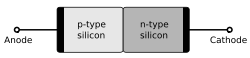
First, lets look at the generic diagram of a simple P-N junction diode:
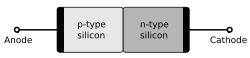
The 'P' junction is a semiconductor (generally silicon) doped with a trivalent element, like boron, so that it becomes an electron-deficient species. They have electron acceptors, or 'holes'. As always, the guys behind this liked to complicate their lives and ours, so by convention, we talk of the 'holes' moving, rather than electrons. The trivalent dopant atom (Boron), cannot properly bond with the neighboring Si atoms; one of the four bonds lacks an electron, which it readily will accept from any source it can lay its hands on.

The 'N' junction is a semiconductor doped with a pentavalent element, like Arsenic, so that it has an extra electron (as compared to the usual four). They give out electrons. The As atom has an electron, after using four of its electrons to bond with its neighbors. The bond energy of this electron is pretty weak, and the electron can easily be cajoled into leaving.

Let's move on to the function of this simple device. As soon as you join these two 'junctions', the electrons from the N junction immediately 'neutralize' the holes of the P junction. This creates a void space in the middle in which there are no charge carriers. Note that a conductor conducts only due to carriers, and hence the absence of them makes the void space an insulator (a very thin one though). This region is called a depletion zone.

Now, as with all insulators, and all materials in fact, if you force it enough, you can get electrons to flow. When the holes and electrons have met, they leave behind a positive dopant ion, and a negative dopant ion. Yup, you know where I'm going with this, a field is established in the reverse direction. So, if you establish a sufficient potential difference between the two ends, the electrons have enough energy to make it through this gap, and current can be established. In general, I've seen most references say that the gap closes, but I feel that is simply a convention established, to easily explain the phenomenon.

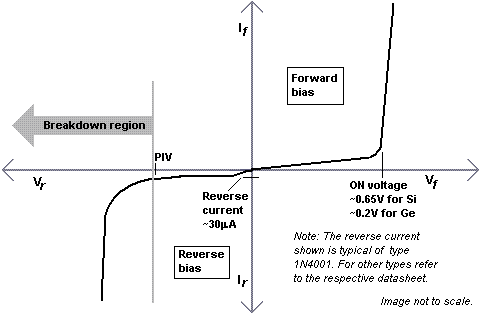
A good question to ask at this point is after the electrons jump the gap, shouldn't they fall into the holes again? In fact, they do, and that is why there is some potential drop across diodes. A key difference between semiconductors and conductors is the number of electrons/holes it has is finite. That means that you can fill them all, and go on with life. That is why the graph of the I-V of a diode isn't just a right angled line.
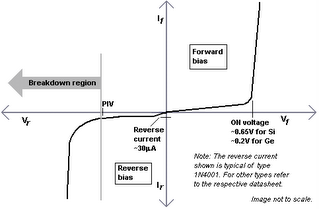
There are two ways a diode can be connected, forward bias and reverse bias.

Forward Bias: In this setup, the positive (or higher potential end) is connected to the P junction, and the negative (or lower potential end) is connected to the N junction. This will establish from P -> N. That means the electrons are pushed from N -> P, which is a good end. The N junction has excess of electrons anyway, and the depletion layer potential is in the P -> N direction. So the external field overrides the internal field, and the electrons merrily cross the depletion layer. Once the potential of the depletion layer is reached, the current jumps up to its normal value, from a meager trickle earlier.

Reverse Bias: If you were to flip the connections, and connect the P junction to the negative terminal, and vice versa, then you would create a field in the direction of the internal field, increasing the gap. You would get no current in this manner. However, if you increase the potential enough, the material of the diode breaks down, and suddenly allows a lot of current to flow. This is called avalanche breakdown.

Now you know how a diode works. I know most of you already know this stuff, but I had to clear the way for the other topics.

Coming Soon: Transistors...

Thursday, December 28, 2006

Strange wall-ball problem


Okay I get it - the title is not that imaginitive.
Hi there! The organic post that was to be never came up because I left my copy back in school but its some pretty interesting isomerism nuts that I was shown by my teacher. For now its some physics- collision style!
In fiitjee and other study mats there is always this obscure thing that concerns a ball with a wall. (Wall=infinite mass, ball=m)When the ball collides with the wall having an initial velocity u it returns back with the same velocity provided that the collision is elastic. Now fix the ball, let the wall strike the ball with a velocity u.Whatt happens now?

Contrary to all common sense the ball lurches forward with a velocity 2u.why??
A friend of mine kaustav sengupta (never mind the too erudite tone of the sentence) made sense when he said that consider the first case as in figure1, the frame instead of being stationary with respect to the ground is having a velocity u to its right. then?/Â…..we get the second case, fig2, minus the comment about not making sense.
Comment if u knew it
Comment if u did not
Comment if u think itÂ’s wrong
Comment anyway!

Sunday, October 22, 2006

BEFORE THE BEGINNING AND BEYOND THE END (PART 2)

Hello again all of you. I am back, with a spicy second part of my article. The contents of this article as well as the one it follows is a collection of well laid facts cemented with the author's own ideas. Thanx 4 reading guys, enjoy. Please refer to the previous section wjenever in doubt.


Let us now extend our view of the symmetry about the big bang, we can go forth to say that the previous universe too must have originated from another big bang. Therefore, this brings us back to the concept of oscillating universe theory. However, the problem with oscillating universe is Entropic considerations. The problem is the following:

The oscillating universe theory says the entropy of all the singularity states of the universe have same entropy. Now let us assume the whole of the universe as one system. Suppose right here right now, I drop an egg and break it. I have thus increased the entropy of the universe. However, when our universe reaches its next big crunch, the entropy has to be same as that of the last singularity. There is the problem, entropy remaining constant although the system is experiencing an irreversible process. I will try to provide an explanation for it.

All of us know about supernovae explosions. Some parts of a dying star blows off as a huge explosion into the realms of the vast universe, and the remaining collapse into a tiny dwarf star. Let’s apply this logic to the entire universe.

Let S1 and S2 be two singularity states. A big bang at S1, expansion, and then contraction and finally a big crunch at S2 are the sequence of events. The change in Entropy is ΔE. According to Boltzmann postulate or the definition of Entropy,
ΔE = kb (ln Ω1 - ln Ω2) where, the sigma are the no of ways in which the same microscopic arrangements can be restored from a starting state.
So what we do now is very simple. We ‘transfer’ all the disorder in the whole of the universe to say a few moles of gas molecules. We outcast there molecules and allow the rest of the universe to move into singularity 2.

Let me make this more lucid. While playing billiards (or pool or snookers ... whatever), on a perfectly friction less table, we first break the triangular arrangement in the middle by a slow strike, the balls go a little haywire and keep moving and colliding with each other. As these collusions continue, the entropy is constantly increasing with time. But there is a remote possibility that say seven of these balls will again come back and form a tight arrangement. The remaining two will remain in a state of even increased randomness. Thus we can say that the entropy got localized to the two balls or got transferred from the other seven balls to the two.

This is one way in which we can satisfy both the oscillating universe theory and the second law of thermodynamics. But this too has a lot of problems of its own. First and the most important is that it is unable to explain the birth of the universe (I am talking about the real birth – the first big bang) and it too says that there has to be some thing beyond our universe.

It says our universe is constantly losing its mass into darkness (dark energy?). It predicts a very gruesome death to our lovely universe. A heat death scenario – a situation when there will be no energy gradients and hence there will be no process. (All processes require flow of energy.) But certainly it has done one good thing for sure, it has increased the life span of our universe to much beyond of what Big bang theory had proposed. It never says that the Big bang theory is wrong but it says that the big bang was not the beginning but only a phase change in the history of our universe.

I will not end this article with a conclusion as conclusions are for the readers to devise. It is a philosophical question and until we find a proof we can only speculate. We are like a child who presses its nose on a mirror, accepting it to be window. He knows it is not the reality. It is only the preconception in his mind. Reality lies beyond the glass- break it open. But he is afraid that in the process of breaking open the mirror and discovering the reality, he will destroy his well constructed sand castle.

Saurya Time Mishra

PS: Sorry if u couldn't c the comments before. Dunno y, but still, u can add them now!

~Gr81~

Wednesday, October 11, 2006

Modern physics and Vedanta.

Ok, I agree the topic seems to be a turn-off but the ensuing article might just not be one. Actually I read a book of the same name by swami jitatmananda (a gem by all accounts –google him if u like). That along with a few observations of mine constitutes this post. So, back to the topic .Vedanta defines maya as sthana-kala-nimitta (ie space time causation). Without either one of these the other one has no meaning – nor does maya. Rings a bell –einstein’s space time continuum et all?-it should.
There is also the question of consciousness. It has already been mentioned in the Upanishads (or vedantas for that matter they are the same), that consciousness/awareness/opinion, whatever one may call it, affects the surroundings. And it has only recently been proved that the outcome of an elementary experiment (which can have only 2 outcomes) can be affected if the scientist conducting it has a biased opinion –all this is actually much more complicated than it sounds- but that’s that. There are similar mergers in oriental philosophy and occidental science that are increasingly evident even as we speak. Scientists like john a. wheeler have coined mouthful names for the phenomenon but I left the book at my hostel so I cannot quote. But this still might open avenues of thought open to many of u. and if u ask me, gita seems lifeless to me- Vedanta packs in much more excitement & cloudy aura. Issue a translation from ur library and go through it. Gita, on the hand was a part of Mahabharata which was purely a literary creation. Gita, once translated seems bland but yeah it uses devices and metaphors well. I don’t know that much Sanskrit but ppl seem to go gaga over gita – its just common sense! Or thus I think,well then each to his own.
How do u ppl like resonance though? For me some articles drive well, while most yield a tangent (vidyapith colliloquy for did-not-quite-get-that).
Now look here I am absolutely greedy on feedback so do comment.

Sunday, October 01, 2006

BEFORE THE BEGINNING AND BEYOND THE END

Part 1


There was nothing at all, no space no time (not even me), then all of a sudden it all happened - The Big Bang. A theory we all have believed so blindfolded. A Theory that created a bigger bang in the world of science than the Big Bang itself. A theory that certainly could explain cosmic background wave and the red shift of the expanding universe, and even satisfies religious claims of things like God making everything. Everything is completely all right until we step beyond the beginning. People have asked numerous questions, “What was there before Big Bang?” The scientific community with a Godly authority turned all of these questions down. I will not repeat them.

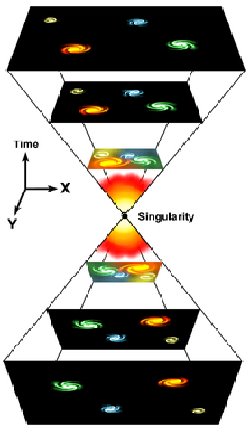
But this was not all. This theory at last seems to be breathing it’s last (and thank God). The theory, which was once rejected, is now betting a rebirth – The Oscillating Universe theory. The General Theory of relativity, which so well explains everything regarding gravity, fails miserably in what we call Singularity – space and time condensing to one point – densities touching incredible values and distances reducing to about 10^-39 - the plank scale. And the reason? The same thing, which my dear blogmate Arun and I have been arguing upon – Calculus. We all know that charge is quantized, so is angular momentum of electrons, even mass. Let us take a step forward and extend quantization to time and space. Space is nothing but a fabric woven out of individual fibres. Calculus cannot be directly applied over discontinuous space. However applying it with a little modification allows us to end all problems. This theory is popularly known as the Loop Gravity Theory and interestingly but as expected originated in India.

The Theory was aimed at explaining the physics at plank scale which it did successfully. However, it led to another implication and directly counters the concept of the Big bang.. When all matter in the universe approach singularity, the theory says, there comes into play a force – one of tremendous magnitude, manifold greater than gravity itself and repulsive in nature. The situation is similar to a ball hitting a spring and bouncing back.

Certainly with this knowledge we can answer the most controversial question, “What was there before the big bang?” The answer is there was the countdown to a big crunch. We now have a universe that does not begin at the big bang, but only is symmetric about it.

What I want to say is here – Wasn’t it Obvious? We should have guessed it earlier. Let me explain why and how.

I would like to repeat the philosophy of a 2nd century Chinese philosopher. Every event is preceded by another event. (The former is the cause of the later) Hence, the implication follows that there has to be some thing before the Big bang the cause of the Big bang, more specifically. (Speaking further, we can say that there should be no beginning to the universe, but we will see to that later) To further justify the statement, and denounce the creation of space-time at t=zero (and with it the Big bang theory), I will give the following argument.

Let us say there was a primeval atom, which exploded to create the universe, space and time. The question is why at all did it explode? This can be answered in two ways. Firstly there was some thing (or someone …say God) outside it who/which caused the Big bang to happen. That means, there was something – matter, energy or say a consciousness excluded from the Primeval atom. But this is against our Big bang theory. The second way is to use probabilistic mechanics. The primeval atom just like a radioactive atom had a probability of disintegration at any given time. (I am sorry, but using probability without the concept of time is just impossible.) So there has to be Time before Big Bang. This again violates the Big Bang theory.

I would love to write more but its not possible in a single blog. I will put it all in the second part very soon. So stay tuned, the sting is in the end, I assure you.

Saurya "Time" Mishra

Friday, September 15, 2006

ENTROPY has INCREASED AGAIN

HEY BLOGMATES !!!

& Heyy Arun...
Your previous comment appeals to me big time for I'll share something with ya pal ! Even as I write this, therez a thought in my brain telling me to do it with adibatic & reversible processes as far as possible so that there is least increase in the entropy of the universe. When I walk, I think of taking the shortest route possible only because I don't want entropy to increase. Only that I realized it sometime last year that thinking to conserve entropy, I was infact increasing it ! The entropy I saved walking a hypotenuse-cut through a park was little compared to the effort I spent thinking about it. The heat released in my brain, the possible disorders etc etc.
Today it occurs it me, whether it was of any use ? Is entropy actually that bad ? Infact is a broken glass any worse than a not-so-broken one ? Well, science discusses the objectivity of a problem but what decides its subjectivity ?
Infact whats the definition of wrong & right ?
NOW ... thats too many questions at once ! That too very much varied.

Well. Okay. what about "" DISORDER "". Thats what ENTROPY if a degree of. But if ""DISORDER"" really that objective ? Or mayb we can define DISORDER in terms of entropy. Well, then is an act of murder a disorder or order ?
Im sure this is not a question answerable by science. Nor does science intend to adress such queries. But wat about them ?
I have a little piece of writing on entropy that I'll shortly post, something that I wrote an year back.

As for H U P , hmm... even I went through the same thoughts once! Though its intriguing to know that waves of particlas are considered to be waves only because there is to means to look into the wave !
Infact the de-Broglie thingy is pretty much the same thing as the HUP... just 2 ways to say the same thing. The same thing being that weather we say that there exists a particle which is smeared across a region in space, or there's a wave not a particle which is present, its the same thing !

Indeed theres a lot of similarity in our thinking Arun ... hmmm

Newayz.

Will try & be regular with some posts !


TWISH
PS: Sry Gawd for all this increase in entropy...

Saturday, September 02, 2006

I Hate Capacitors

Hi guys,
Some thing has been eating me for days. Its about capacitors and may sound trivial but I wil assure u it is not so. The question is: "what will be the capacitance of a parallel plate plate capacitor when it is filled with a conductor touching both plates."
All books I have seen so far say it will be infinite or tends to infinity, but i dont agree. I will put my view point.

let us go to the grassroots and define capacitance. The ability of a capacitor(or any object for that matter) to 'store' charge at a given pottential difference. Now once both the plates are connected the whole assembly is nothing but a conductor. Two statements here:
(i) Any conductor except a superconductor has some resistance, no matter how small, it is non zero. Thus there will be some pottential drop. V not= 0
(ii) No part of a conductor can accumulate any net charge, because of the presence of charge carriers (electrons). Q = 0
Thus the capacitance C = Q/V = 0/non zero = 0

Now some thing very very absurd(funny rather) is written in one of the books (Arihant Electricity and magnetism). It say since a conductor can allow infinite amount of charge 'though' its plates, Q>>>>V. So C tends to infinity. Wah bhai !! Listen to my analogy. Take a bucket, cut off its bottom and say u have a bucket of infinite capacity !! LOL !!

Intrestingly and disgustingly nearly all physics trachers disagree with me. i am the lone fighter for my cause. I have ddecided to conduct an extensive experiment on this starting from 25 Sept after the FIITJEE exam ;) So what do you people think? Am I wrong ?

Saurya Time

Tuesday, June 06, 2006

FROM JUNK TO VAN DE GRAFF GENERATOR


Ciao everybody,
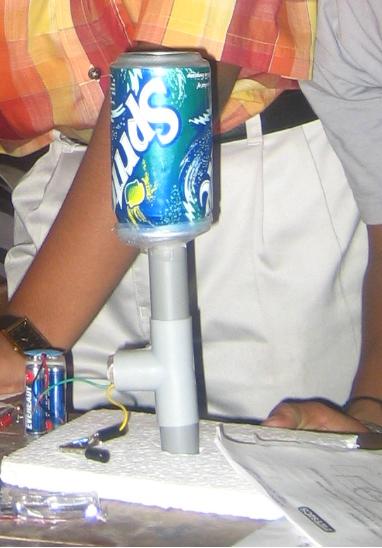
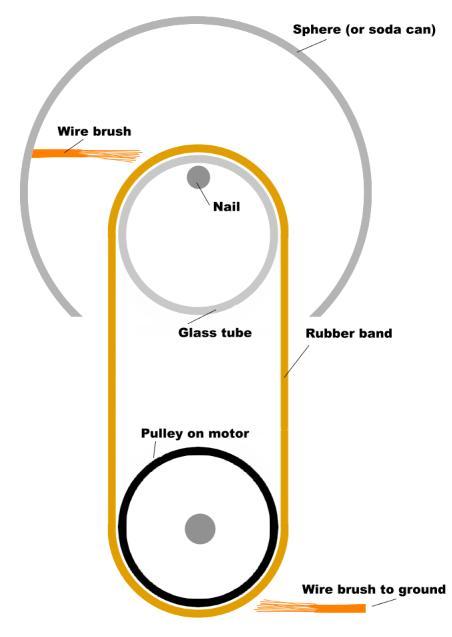
This was my new project (more of a fun than a project)… I have made a van de graaf high voltage generator out of junk. Total expenses u wont believe it … Rs 25/- and a few costly hours of mine.
As u fellows know better that a van de graaf gen generates a very high voltage of the order of few millions. Just refer an NCERT class 12 book and u have a very nice topic on it. The major change that I have done is that I have used ‘theiboelectric’ effect instead of a high-tension battery.

We have certain materials that lose electrons readily and some that gain them easily. Here they are glass and rubber and plastic. I will not bore u with my worthless writings u see the pictures and comprehend likewise. I was helped by one of my local friend ... Avinandan rout. He is as talented as any of us only he could not make it to the KVPYians. I will also attach a schematic diagram to help in the comprehension.
The gen takes a lot of time to charge fully but ur hair does stand up. I specially thank Mr. Samuel Q. Field 4 his help. The idea was his but I modified it in several ways to make it better.

The van de graff gen was presented in the ‘The Uranium camp 2006’.
Just tell me if u want a detailed description and I will do so. Also if u want 2 know more about the Uranium camp (and the fun: I would love to write about it) just tell me.

Saurya "Time"
(Time is back)

Friday, June 02, 2006

DEAD ENDS : Part III : Justified lies


Here I am !
Bored of 2=1s aren't ya'll ? Here are some more of classic lies, told in the most decieving manner !


(1) *** classic *** ( Some PHYSICS for a change )
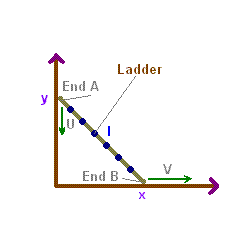
There in the figure, we have a ladder leaning against the brown wall. Its length is l & the two ends are labelled as A & B. End B is pulled in the positive direction of the x-axis with a constant speed V. The velocity of end A in the downward direction is U ( variable ). x,y are the respective coordinates of the two ends.

x2 + y2 = l2

differentiating w.r.t. time we get :

2.x.∂ x/ ∂t + 2.y. ∂ y/ ∂t = 0

2.x.∂ x/ ∂t + 2.y. ∂ y/ ∂t = 0
2.x.V = - 2.y.U(x)
U(x) = - x .V/ y

Now, when ladder falls completely, and becomes flat, then y = 0 & x = l.

To calculate the veocity of end A when ladder just becomes flat, we put the values in equation for U(x) getting :

U ( l ) = - l.V/0 = - ∞

So the velocity of end A becomes infinite when the ladder becomes flat ? !


(2)
We are all aware of the theorem of Mathematical Induction. However, none would have seen its misuse. Here is one such misuse which is horribly difficult to disproove !!!

Statement to be verified is :

S(n) : In any set of n people, all would have equal ages.

Now we proceed :

S(1) is true ( Since in a group(set) of 1 person, all have equal age. )

Let S(k) be true.

Now ;

In a group(set) of (k+1) people, we make all possible sets of k people. In all these possible set of n people, S(k) would be true (as per assumption) and hence all people in each of the sets would have equal members. Now since all such possible sets would have members of the same age, this is only possible if all the members in the (k+1) member be equally aged. Therefore All people in the set of (k+1) people have equal ages.

Hence S(1) is TRUE & S(k+1) is TRUE whenever S(k) is TRUE.

Hence prooved by mathematical induction , the TRUTH of statement S(n) for all n belonging to N.

Application of the above theorem for the set of BLOG MEMBERS "B" We conclude that All members of this blog are of equal age.
QED


(3) *** classic ***

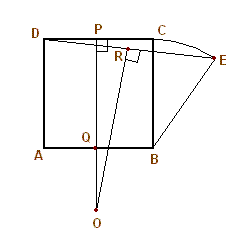
ABCD is a square. BE = BC.
PQ bisects CD,AB.
OR is perp.bisect. of DE.
PQ, RO intersect at O.
∠ ABE is an OBTUSE ANGLE. ( clearly )

Δ ORD ≡ Δ ORE (SAS)
:. OD = OE

Δ OQA ≡ Δ OQB (SAS)
:. OA = OB & ∠ OAB = ∠ OBA

Δ OAD ≡ Δ OBE (SSS)
:. ∠ OAD = ∠ OBE
∠ ABE = ∠ OBE - ∠ OBA
= ∠ OAD -∠ OAB

But ∠ OAB - ∠ OAB
= 90 °

:. ∠ ABE = 90 °
However, we've assumed the angle to be obtuse. :. Every obtuse angle is a right angle. Similarly, It can be shown that every acute angle is a right angle.
QED


This is part III and I'll let ya'll know that 3's my lucky number. So hereby, I quit with this series. Not that the resources are over ! Infact they're endless. But today eve, I'm leaving for Delhi & I won't be able to be online so regularly. Though I'll surely stay in touch atleast twice a week !

A last message. I believe that us KVamPYs are special in some way. I also believe, that we can be a great strength when united ! So here's a request. Mayb you can't come online very often but do stay in touch by atleast going through the blog once a week !!!

This blog is for us KVamPYs, by us KVamPYs & of us KVamPYs.

So letz ROCK ... letz RULE !!!

& Ill borrow Rash's line...
SwItCh On Ur BuLbS !!!

~ Twishmay Shankar ~

( Twish ;-) )


span>


Sunday, May 28, 2006

The Lion MUST be caught ?!?

Car pulls ( engine pulls rather ) with force F.
Car moves with constant velocity V.
:. Net force on car = 0
Force by dissipiative forces such as friction = -F.

Now ; P = δW/δt = δ(F.s)/δt = F.δs/δt
Now since velocity is always relative, δs/δt = u is always relative!

However, since there are two powers acting, one by friction & one by engine, & net F = 0 , the net power on car is 0. This is from ground frame.

If a cycle follows at velocity U, in frame of cycle, the cars velocity = V-U. It is wrong to say that cyclist would say the power delivered by engine is F.(V-U) because the cyclist finds the car not accelerating & hence he caculates the work done by engine to be 0. The cyclist has no direct means to find from his frame what the work done by the engine alone is. ( Cyclist can't measure F, the internal force )

Besides, whenever engine applies a POWER, it makes the car accelerate. And acceleration is independant of relative refrence frames.Both someone on the car and on the cycle would measure the same Acceleration & hence find out the engine's power ( in absence of dissipiative forces ).

To get my point, try to sit on a cycle & follow a car (running at constant velocity) & think of an experiment to determine the power of its engine! You can do so by guessing at its friction, but not directly! This is the key to the problem. Work done is relative.

Therez another realated interesting thought. WHEN WE CLIMB STAIRS UPSTAIRS OR DOWNSTAIRS, THE NET CHANGE IN POTENTIAL E IS THE SAME. THEN WHY DO WE GET TIRED WHILE CLIMBING UPSTAIRS TO A GRATER DEGREE ???

Tuesday, May 23, 2006

Watz ur Wattage ?


Herez a puzzle:

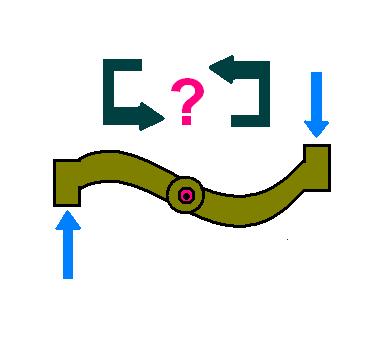
I hope every1 has seen those water sprinklers spraying water in a garden. Nice little things they are, for they rotate by themselves throwing water around! Its obvious that laws of momentum conservation are the secret behind the working of this interesting gadget. But here comes the catch. Imagine that water is not made to gush out of the sprinkler. Instead, it is dipped in a tank and by some means, water is made to flow inside it. There can be 2 such possibilities :
  • The pressure outside is increased
  • The pressure inside the pipe is decreased.

The question now is ... is water flows as shown in the figure, which way would the sprinkler rotate ? ( Aniclockwise or clockwise ? )

Plz don't post you answers here, email them to twishmay@gmail.com with a satisfactory explanation.

~ Twish ~