
|| Welcome to the Blog managed by the KVPY 2005 Batch || Twish asks members to comment on the blog MaKeOvEr!! || RG says: Looks like a famine situation here || Blog glows in bright shades || KVamPys tame their own minds... with new mysterious posts on TP ?! || What is TP after all ? || KVamPYs start thinking about their Summer Projects as the Entrances are about to end.. || IIT? IISc? IISER? KVamPYs wonder where to enjoy this summer.. || Obiwan and Sunita in ISSER || Arun awaiting replies to his letter. || Swetabh ( Bhakt ) and Abhilash trying for IIT Kanpur ( Along with Twish ) || What about the next year ? Apply again for KVPY ? || Bulbs light up as blog fills up with posts. || Latest News brought to u by Twish (Twishmay) and Rash (EMAIL US NEWS) || EvErY bOdY KnOwS..... KVamPYs RoCk!! ||

Sunday, January 07, 2007

Basics of Electronics: Diodes


Well, this is going to be a lengthy specialized article. I don't know how many of you have worked with circuits (as in solder circuits), but I atleast can vouch for myself, and Twish. I'll just explain what goes on behind the diode, the transistor, and the op-amp. We've already covered the others, i.e., resistors, capacitors and inductors in our syllabus (technically, diodes are in my syllabus too, but we've not covered them). I'll then go on to explain a very very simple IC, the 555 timer. I'm not sure at this point whether do post them as parts or as a whole. But I resolved to finish the entire article today, so at least I can post the bits and pieces over a few days.

Diode:

First, lets look at the generic diagram of a simple P-N junction diode:

The 'P' junction is a semiconductor (generally silicon) doped with a trivalent element, like boron, so that it becomes an electron-deficient species. They have electron acceptors, or 'holes'. As always, the guys behind this liked to complicate their lives and ours, so by convention, we talk of the 'holes' moving, rather than electrons. The trivalent dopant atom (Boron), cannot properly bond with the neighboring Si atoms; one of the four bonds lacks an electron, which it readily will accept from any source it can lay its hands on.

The 'N' junction is a semiconductor doped with a pentavalent element, like Arsenic, so that it has an extra electron (as compared to the usual four). They give out electrons. The As atom has an electron, after using four of its electrons to bond with its neighbors. The bond energy of this electron is pretty weak, and the electron can easily be cajoled into leaving.

Let's move on to the function of this simple device. As soon as you join these two 'junctions', the electrons from the N junction immediately 'neutralize' the holes of the P junction. This creates a void space in the middle in which there are no charge carriers. Note that a conductor conducts only due to carriers, and hence the absence of them makes the void space an insulator (a very thin one though). This region is called a depletion zone.

Now, as with all insulators, and all materials in fact, if you force it enough, you can get electrons to flow. When the holes and electrons have met, they leave behind a positive dopant ion, and a negative dopant ion. Yup, you know where I'm going with this, a field is established in the reverse direction. So, if you establish a sufficient potential difference between the two ends, the electrons have enough energy to make it through this gap, and current can be established. In general, I've seen most references say that the gap closes, but I feel that is simply a convention established, to easily explain the phenomenon.

A good question to ask at this point is after the electrons jump the gap, shouldn't they fall into the holes again? In fact, they do, and that is why there is some potential drop across diodes. A key difference between semiconductors and conductors is the number of electrons/holes it has is finite. That means that you can fill them all, and go on with life. That is why the graph of the I-V of a diode isn't just a right angled line.
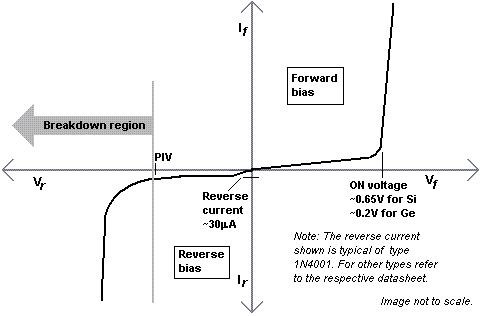
There are two ways a diode can be connected, forward bias and reverse bias.

Forward Bias: In this setup, the positive (or higher potential end) is connected to the P junction, and the negative (or lower potential end) is connected to the N junction. This will establish from P -> N. That means the electrons are pushed from N -> P, which is a good end. The N junction has excess of electrons anyway, and the depletion layer potential is in the P -> N direction. So the external field overrides the internal field, and the electrons merrily cross the depletion layer. Once the potential of the depletion layer is reached, the current jumps up to its normal value, from a meager trickle earlier.

Reverse Bias: If you were to flip the connections, and connect the P junction to the negative terminal, and vice versa, then you would create a field in the direction of the internal field, increasing the gap. You would get no current in this manner. However, if you increase the potential enough, the material of the diode breaks down, and suddenly allows a lot of current to flow. This is called avalanche breakdown.

Now you know how a diode works. I know most of you already know this stuff, but I had to clear the way for the other topics.

Coming Soon: Transistors...

Friday, January 05, 2007

Biology & Astronomy - Questions, not Answers

Alright. Two things being tossed off my mind here.

1) Why February?

So when the calender was first made (gregorian), the months were given days according to the motion of the moon. Also, it was noted that a year is about 365.25 days, so a leap year was added every four years to negligate the approximation of 365.

However, it was noted that the days in one month had to be truncated to fit in 365. And then they truncated them from Feb. And now we can't rely on the day of the month to find the location of the moon.

But why were these days removed only from Feb? Why weren't the number of days in every month made equal?

2) Negative Half-Life?

Although a half life is negative, as in it is for decomposition, is there anything opposite to the phenomenon of exponential decomposition?

Take the example of Cancer cells. They divide, then the two cells again divide etc. The rate of reproduction increases over time. My question is, is there an accurate exponential formula for this? There really should be, according to physics, but there may be factors which inhibit the reproduction of a particular daughter cell of a cancereous parent...

3) Time travel

You will just have to wait for the release of my book.

Thursday, January 04, 2007

Introducing...

Hello, people.

I am not one of the "bright students of India getting the KVPY Scholarship". Nope. I'm just here for the absurdity of it all.

So let me introduce myself. I am Rohit Garg. Also called RG.
First off, I'm sort of obsessed with light and invisibility (and spinvisibility). Also studying the possibilities of time travel.

I also like blood as a colloid buffer. I am partially insane, but I believe you geniuses (or genii) can put up with that.

Also love computers.

Thursday, December 28, 2006

Strange wall-ball problem


Okay I get it - the title is not that imaginitive.
Hi there! The organic post that was to be never came up because I left my copy back in school but its some pretty interesting isomerism nuts that I was shown by my teacher. For now its some physics- collision style!
In fiitjee and other study mats there is always this obscure thing that concerns a ball with a wall. (Wall=infinite mass, ball=m)When the ball collides with the wall having an initial velocity u it returns back with the same velocity provided that the collision is elastic. Now fix the ball, let the wall strike the ball with a velocity u.Whatt happens now?

Contrary to all common sense the ball lurches forward with a velocity 2u.why??
A friend of mine kaustav sengupta (never mind the too erudite tone of the sentence) made sense when he said that consider the first case as in figure1, the frame instead of being stationary with respect to the ground is having a velocity u to its right. then?/Â…..we get the second case, fig2, minus the comment about not making sense.
Comment if u knew it
Comment if u did not
Comment if u think itÂ’s wrong
Comment anyway!

Friday, December 15, 2006

the return of sith :-)

hi there! i came back from skool yesterday and went through the whole blog. the idea was great i think.to start a blog that lays importance to the subtle nuances of physics and maths(not much of a chemistry there).and i m rlly happy that the posts have not dried up.as per catching up - it was good to hear that ftse was actually a mess. u know wat? a friend of a friend of mine,mutual friend that is, reads in fiitjee delhi classroom courses and he told us that they were taught in advance in the discussion classes abt 80% of the sums - a leak if there ever was one.assuming of course that he wasnt, u know, throwing off.anyway i was down in confidence for weeks.sort of brings things into perspective, doesnt it?
anyway i will be posting one on organic pretty soon - its been neglected for long.
pss:i will be staying here till 27th.then i wont come back to home till march.